Showing posts with label Wheelchair. Show all posts

Wednesday, 15 March 2017

Yes, Disabled People Wear Lingerie.

[Image: black and white photo of a walkingstick in a window with a bra handing from the handle. And because it didn't occur to me to dust, there is a scattering of dead black insects and some cobwebs on the white windowsill.]

Last year I rolled into a lingerie store to check out a rather fabulous emerald green bra and undie set that had caught my eye in their display window. I rolled around the tightly packed store grazing racks of g-strings and t-shirt bras until the inevitable happened. On the back of Lucille (my electric wheelchair) are a set of handles that allow another person to push the chair if I run out of batteries or become too incapacitated to manage my joystick. I forget they exist 99% of the time. They are behind me and I am highly unobservant even on my good days. The 1% of times are times like that day when, dazzled by the wall of lace and satin, I had deviated 1° off my safe path and caught a rack of lace teddies on a handle. I promptly pulled the entire rack of teddies to the floor. I stopped mortified as the loud clatter of plastic hangers dwindled into silence. Looked back to find a pile of plastic and lace on the floor and a single sad white teddy hanging haphazardly off one of my handles. I waited for assistance.

And waited.
And waited.

The attendant didn't even look at me and I was faced with a set of tight, black clad shoulders that either belonged to the ghost of a past store attendant, or, she clearly had no intention of turning around. Embarrassed and leaning precariously from my chair, I tried to pick up the pile. When it became clear my attempts were going to end in a possible worsening situation, that of an uncoordinated disabled woman plummeting from her chair to take out an even larger display of lace and satin, I leaned back. I twisted. Grabbed the lone teddy from my handle. Hung it back up on the chrome display pole. And rolled out. When I looked back the attendant was clearly relieved I was gone.

At no point from when I rolled in to when I left did she make eye-contact. She saw me enter, turned her back and continued to speak to the only other woman in the store. I felt like I was back in high school when the cool girls would deliberately ignore my decidedly uncool self. The classic exclusionary tactic employed by teenage girls throughout history: turn your back and continue to talk like the uncool girl never entered the room and doesn't even exist.

It was clear that I was not welcome. 
A disabled woman in a lingerie store? 
No thanks.
Too difficult.
Too ick.
Too "why would a disabled woman even want lingerie?"

I know I'm not alone in this experience and have had multiple conversations with  disabled friends who have felt excluded or discriminated in lingerie stores. People have difficulty with the concept of disability, and in turn interacting with disabled people. But the combination of disability and sexuality makes people profoundly uncomfortable. However that sexuality is expressed, from purchasing lingerie to dating, exploring sexual identities, or participation in different lifestyles, it quickly becomes clear that society doesn't want that connection to exist. (There was a massive blow up on a popular disability site a few years ago when a sex positive story about a disabled adult attending a completely legal sex party in Canada was published. The gentleman in question found it a celebratory, inclusive and empowering event. Responses were clearly split between those who did and didn't have lived experience of disability. Disabled commenters were predominantly happy for him. However, many parents of disabled children, carers, and adults without lived experience of disability were horrified even threatening to report the event and the group to authorities. Similar responses also occur when there is mention of the use of sex workers to aid disabled people in exploring their sexuality.)

Disabled people are seen as asexual by many. Or undesirable. Or as frequently comes up in comment boards when disability and sexuality are discussed, special snowflakes, or forever children who should not be sullied by icky notions like sexuality. Many simply go straight for the "how could a disabled person possibly consent to sex or any expression of sexuality?" That there are different types of disability, that we could consent, or be taught about bodily autonomy, choice or safe sex practices doesn't even enter the public conscience. That sex is a part of the human condition and should be considered a human right for non-disabled and disabled people alike is rarely discussed. We are not supposed to be confident or feel attractive. We are not supposed to own our own experience. We are to inhabit the realms of pity or inspiration and never dare to mention that our wants and needs are strikingly similar to those who are not disabled. And the idea that we might simply want to wear some hot lingerie that makes us feel confident, for ourselves, not anyone else, isn't even in consideration. The woman in the lingerie store let me know that I wasn't welcome. And she definitely didn't see me as a potential customer.

Pfft to you rude woman! I'll spend my dollars elsewhere.

Yesterday, NZ company Lonely Lingerie's new campaign came to light. It stars 57-year-old Mercy Brewer. The photographs show a confident older woman wearing some fabulous sexy lingerie. Stylistically the photographs and the lingerie are no different to what you'd see in a campaign with a younger model. This is not the conservative, stodgy, lingerie we are routinely shown in advertising directed at older women. It is unashamedly sexy. And it is fabulous. It defies so much of the narrative around older women. Women in Mercy's demographic tend to be framed as mothers or grandmothers, and advertising and society tells us there is only one acceptable form of mother/grandmother. I can't help think of Madonna wearing a revealing outfit at the Met Gala last year which was met with cries reminiscent of Maude Flanders "won't somebody please think of the children!" As if motherhood or grandmotherhood, or age, (or disability) automatically wipe away a woman's sexuality and self-expression. As a purple-haired, side-shaved, mini-wearing, 43-year-old, disabled woman and mum of two son's, I call BS on that.


[Image: An older woman leans against a wallpapered wall wearing a black bra. The entire photo is in sepia tones. Text below says "Aging can bring a quiet confidence unknown in youth, what use is beauty without confidence to recognize yourself?" -Mercy Brewer #LonelyLingerie]


I read a piece discussing the Lonely Lingerie campaign that stated that age was the final frontier of lingerie advertising. I would have to disagree and say that disability continues to be the final frontier as we so hard pressed to find any disabled women, or men, in lingerie campaigns. And an older disabled woman? I swear I belong to a group of mythical women dwelling in a land that time and advertisers forgot. I met a woman just like me at a concert recently. She had no idea that other older, less conventional, disabled women in wheelchairs existed. We bonded on shared experience and anger that we are never represented in advertising, or media, or life.

While the lack of disabled women in advertising is clear, it is equally apparent that even the concept of such a thing as diverse women's bodies remains controversial (that mythical land of diverse women is pretty bloody full! And only a few hardy adventurers/advertises seem willing to go searching for those far lands.). There is a particular part of society that is vehemently opposed to diverse women who are comfortable and confident living in a body that much of society and the majority of advertising would prefer be hidden away. Add in any hint of sexuality for those who have a different body type from the dominant advertising norm, and people become even more uncomfortable and frequently vicious.

Today I watched as US company Livi Rae Lingerie's was told that their images of diverse body types, including a disabled woman in a wheelchair were in "poor taste" and should be removed. The images show confident women speaking for and about themselves. These women, like the Lonely Lingerie campaign, defy the standard lingerie images we see that use young, thin, white women/teenagers. When this was revealed, an online campaign developed #NoShameLiviRae, and following the overwhelming publicity and backlash, the decision was reversed. How they were in anyway offensive boggles the mind. Stylistically these photos are definitely more on the conservative side of the ledger, especially when compared to the Lonely Lingerie campaign. And still someone got their knickers in a knot (all puns intended).

Won't somebody think of the children!


[Image: A smiling woman sits in her wheelchair wearing a beige strapless bra and white half petticoat. Caption says: Real Women. "I want to be an example MS or not. People can do what they set their mind to. I always felt the desire to encourage anyone, at any age to never give up and to believe that they are amazing and perfect just the way they are. Even a girl in a wheelchair can be influential" -Stacey Shartley LiviRae Lingerie Ambassador. Livi Rae Lingerie #RealBrasRealWomenRealStories #LiviRaeLingerie]
(Source: Livi Rae Lingerie Facebook Page)


These two campaigns are very different. But in both cases the women are confident. They are from groups who are not regularly seen in lingerie campaigns. They are expressing themselves. And owning their lives and their experience. For themselves and not for anyone else. And that makes many people uncomfortable.

Personally, I love the Lonely Lingerie campaign, and think the company could do great things for disabled representation in the lingerie market.

I want to see a disabled women shown as a confident sexual being.
I want to see what lingerie may look on a body similar to mine.
I want to see her unapologetically owning space and her image.
I want to see her giving a big F U to the naysayers. 

As an older disabled woman, simply seeing an older woman portrayed in this manner made my heart sing. If I were to see an older disabled woman portrayed in this manner I may break out in song and my best jazz hands and spirit fingers.

Diversity in advertising makes financial sense. If companies can't make the move because it is the right thing to do. Then surely attracting a wider market that will increase your profits is attractive.

Diversity in advertising is a powerful tool in changing the way we think about difference in our society.

Diversity in advertising is also powerful for those who are part of those diverse communities. It says I'm here. I'm not alone. I'm part of the community. And I have value just as I am.

I'll never go back to the lingerie store where I was ignored. But I do want to buy lingerie that makes me feel confident.

And I want to buy my lingerie from a company that sees me.

Michelle

Sing it JT!

Tuesday, 16 February 2016

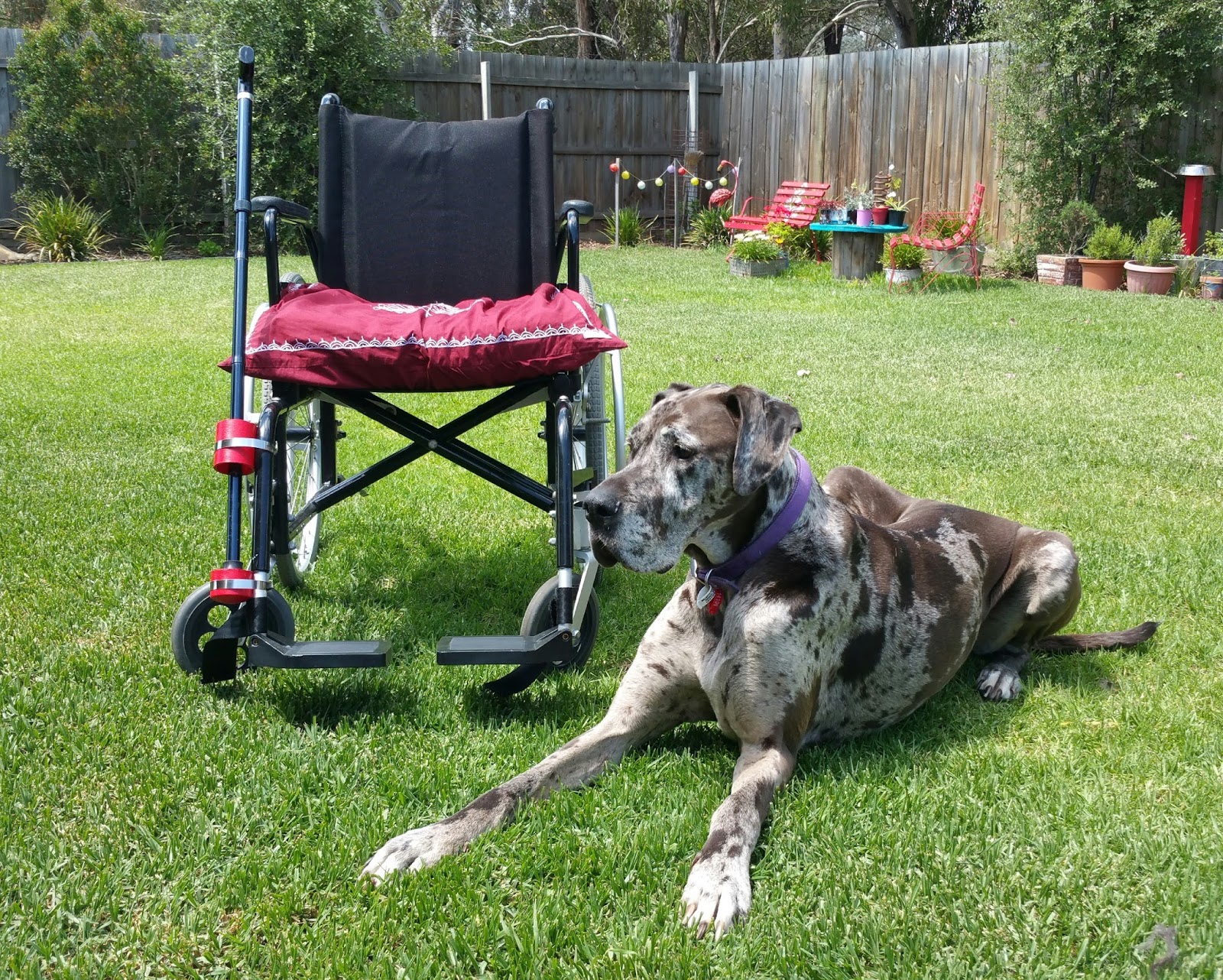
Chronic crafting: Walking stick holder.

[Image: A black wheelchair sits on green grass. It has a red patterned seat cushion and a bright red walking stick holder on the side.]

I spend a lot of time swearing at my walking stick. When I blame it for my lack of coordination and it's tendency to throw itself on the floor should I dare to lean it against a wall or desk. But most frequently my potty mouth is reserved for when I am in my wheelchair, think I have it hooked on the foot rest, only to have it dive sideways, under the foot rest, or it's classic drop and get stuck in a tram track. The slightest bump or if I try to think and breathe, and it's gone.

Times I may have sworn at my walking stick include, but aren't limited to:

At a medical appointment where first meeting a doctor.
In the poorly insulated disabled loo where I'd just managed to make my unsteady way to the loo only to hear a loud THWACK as it hits the sticky tiles.
In the local clothes store when it became hooked on a long sleeved top and was wrenched from my side before my muscles can work out how to react.
In front of my inlaws and, small children.

Such swearing is apparently unseemly, and I fear I may be adding to the angry-disabled-with-a-huge-chip-on-her-shoulder-shouldn't-she-be-all-smiley-and-inspirational, narrative.

So in an endeavour to not let the disabled side down with my surly sweary attitude and because I am completely over it falling off my wheelchair I got my craft on to find a solution. Though in my own defence swearing a lot is apparently a sign of intelligence and trustworthiness, so here's my:

Michelle's Easy Stop My F**kin' Walking Stick Falling Off My Damn Wheelchair Tutorial 

You'll need:
  • 1 PVC pipe straight join
  • 1 PVC pipe cap
  • 2 metal hose clamps
  • Paint whatever you have lying around. I used Haymes Low Sheen Exterior in Carnation. But if you don't have any, a can of spray paint would make life easier. Just make sure it's a hardy exterior paint if you want it to last.
  • Paintbrush
  • Flat head screw driver


Step 1.

Head to your local Bunnings or other hardware store. Get lost in the million isles. Become overwhelmed with project ideas. Make a detour to the plant nursery and buy some more coriander that will proceed to go to seed and never grow properly despite your pleas and tears. Finally head to the right isle after Mr Grumpy starts to develop his FFS face.

Step 2. 

Have your walking stick with you so that you can make sure you are getting the right size parts. Look up at the amazing array of plumbing accessories. Start to feel slightly nauseous and grey because you forgot that looking up is not your friend, and hand it over to Mr Grumpy to grab pieces. Make way out of Bunnings with necessary craft items, doomed coriander, an impulse buy of five pots of instant garden colour and, yet another bucket.

Step 3. 

If you can, buy a can of exterior spray paint. This would make life so much easier. If like me you think, "Hmm I have some left over paint. That'll do." still get the spray paint. Otherwise you will end up swearing at the paint that wont go as smooth as you imagined as you went with the cheapo brush as it was "only a small project". Apply a few layers over the PVC pipe end and PVC pipe straight join leaving time to dry in between each layer. Don't get impatient and cock it up with finger prints or drop the piece that's all dry except for that one edge which just happens to be the edge that you knock against your good dress. Additional tip: Don't be lulled into a false sense of security because it's just a small quick job so you can't be bothered with the effort of changing into old clothes. Change. You/I will always drop something.


Step 4:
Attach each piece to the side of the foot rest on your preferred side. The PVC pipe end piece goes lowest to stop your walking stick falling through. The metal hose clamps come completely apart so you can wrap them around the pipe piece and wheelchair tubing easily. A second pair of hands or much swearing will help to hold the piece in place as you tighten the hose clamps to secure the PVC pipe parts in place.


A tail may extend from the rings. This is sure to catch on everything so remove if possible. My arms of patheticness are not up to the task so I am waiting on Mr Grumpy to fix.


Leave both hose rings a little loose. Place your walking stick in the holes to help line up both parts and to find an angle that works best for you. When you're happy with the angle and line, tighten up the hose rings to stop movement.


And there you have it. No more innocent ears being sullied by my swearing. At least not for this reason. Oh and obligatory Freyja photo as she's awesome, puts up with my swearing and loves the camera.

Michelle

Walk/Roll this way depending on the day.

Friday, 29 January 2016

De Ja Vu: A man stands from his wheelchair and Buzzfeed decides to perpetuate abelism.

[Image: woman standing next to a wheelchair and holding walking stick. Same image is repeated in four coloured squares]

This is a reworking of an old post as this issue comes up again and again. De ja vu from Buzzfeed this time. Ignorant abelist crap and objectification of a person with disability as an object of mockery because they stood from their wheelchair. 


I'm tired. Tired of having the same conversation, about the same issues. Year after year after year. Back when I started this blog in 2009 I was discussing the hurtful comments challenging the validity, or existence, of illness. I have banged on about the whole myth of the look of illness and challenged perceptions about what constitutes disability. I have written so many posts on the topic that I couldn't even pick one to link up. And still, nearly 7 years after I first pushed publish, posts like today's ableist trash from Buzzfeed A man stood up out of his wheelchair after a Roger Federer Miracle shot  (although they are not alone as other outlets such as The Daily Mail Australia also thought it was hilarious), 
are doing the rounds of the Internet on a regular basis. And people continue to find them funny.

A man in a wheelchair stood up when Roger Federer hit a great shot at the Australian Open, and he became the subject of widespread mockery. A man went out to an event using a wheelchair for reasons only known to him. He enjoyed his evening and dared to show his excitement. And people decided he was fair game for mockery. Because disabled people, especially those who don't meet false expectations of disability, are by their very existence, fodder for jokes.

When I write an article many readers tend to relate to the issues I discuss. They have had the same experiences and the same reactions: hurt, anger, frustration, an overwhelming desire to resort to violence. But in many ways this is preaching to the converted. Those who read predominantly share the same views on these topics. But in the wider community it seems that little has changed. 

This "miracle" and "cure" joke, is doing the rounds, again. Because an ignorant and ableist journalist, although I use that term loosely, fails to understand that many wheelchair users like myself, aren't paralysed. Not only that, he trolled through social media to find gifs and tweets from fellow ignorant ableist citizens to share and enhance the hilarity. And what disappoints me even more, a Buzzfeed editor gave it a stamp of approval and it was published. 

The journalist and the posters, have not taken the time to think about the message such an article sends to friends and family who are living with illnesses that don't meet the limited ideal portrayed in the media. It also says a lot about how society, including a major internet site that claims to care about various isms, continues to view disability and illness in this day and age.

It says your illness and your experience is a joke. When they laugh at such an image they are essentially saying you, your illness, your challenges, pain etc are meaningless. When those who use a wheelchair but can still mobilise independently over short distances see such an article it is hard not to take offence. We know the mental and emotional challenge it can take to simple accept the need for a wheelchair. That we have internalised abelism that we must fight every day. We know that a wheelchair means difference at an age where most are simply out living life, starting careers, studying, having children or travelling. We know that every time we head out into the world someone will find our life a joke. Or, if you are unlucky enough to be this man, you and your situation, become a beacon for global for mockery.

I can say we shouldn't care. 

I can say we should simply ignore this article and others like it.

But sometimes no matter how stoic we are, such attitudes cut deep. 


And frankly, why the hell should we have to put up with mockery and disrespect on top of having to live with disability or debilitating illness?

Those who have not personally experienced serious or prolonged illness; who have never known the challenges of disability or seen how they affect a loved one, seem to still find the whole experience as nothing more than fodder for laughter.


What is lacking in our culture that many feel they have the right to mock, judge, or police others, for circumstances they don't bother to understand? When did compassion and minding your own damn business, get replaced with picking others apart for sport?

The idea that the only viable illness is one that lends itself to clear external markers, such as loss of hair or tubes and bandages, is so incredibly incorrect, as to make it laughable, especially given that figures for so called invisible illnesses are as high as 1 in 2 in some countries. The idea that disability is only seen in the use of a wheelchair, something unfortunately perpetuated by the most commonly used symbol for disability found on blue and white stickers worldwide, excludes millions of people in Australia alone (currently estimates are that approximately 20% of the population are living with some form of disability, only a small percentage of those are permanently in wheelchairs). 


The idea that only those with paralysis use wheelchairs is equally damaging to a large percentage of users who, like myself, can walk very short distances but are frequently unable to stand or walk for any substantial distance, or depending on the day, unable even to walk one or two steps. 

Without my wheelchair I would rarely leave my house. Without my wheelchair I wouldn't shop. I'd never go to a gallery or a market. Or even attend many medical appointments. I have even been known to use my limited energy to push myself up from my wheelchair to grab a product from a higher shelf. I could very easily have been the man in that article.

If those who laughed at the article, or mocked others in the community for standing from their wheelchair, took the time to speak to the person in question they may find that they are recovering from surgery or illness or have Dysautonomia, Myotonia, Multiple Sclerosis, cancer, lung disease, heart failure, Ehlers Danlos Syndrome, Arthritis, Chronic Regional Pain Syndrome, or a host of other disabling conditions. 


But should these people have to explain themselves to the mockers? 

Should they have to lay bare their medical history to receive a basic level of respect?

Should we all wear coloured vests or carry neon signs stating our sick credentials to be treated with dignity?

This and other instances of the same"joke" (here, here), that continues to make the rounds on the Internet, is nothing short of insulting and reflects a basic lack of empathy and character upon those who both continue to share it, and those who laugh or say nothing.

I am tired of having to justify my existence to the wider community. I am tired of friends having to justify the use of mobility aides such as wheelchairs. I am not here to educate every idiot who finds this crap funny. I have enough on my plate to deal with on a day-to-day level. I don't need the added burden of playing the role of teacher every single day, day-after-day, year-after-year, for people who don't bother to think of how their attitudes affect those of us who have been in that man's position, or that man himself. Or who don't realise that they, or someone they love, may one day develop an illness or acquire an injury that will put them in such a position.


This is not about a lack of sense of humour, as is often the accusation made when people like myself question such jokes. Many of us in the chronic illness and disability community have well developed senses of humour. It is what helps make our lives bearable. We find the funny in the most unfunny of experiences. But we are using our own experiences, we mock ourselves not other people. We tread the hard path, the pain, the fear, the tears and the doubt, and we have the right to use our experiences. Others do not.

It is me who cannot stand, who collapses on the floor, who vomits up food on a regular basis, who cannot always hold a glass, and who cries into my pillow from the often unrelenting pain in my body. It is me who is often unable to walk from my bed to my bathroom and has undergone numerous painful and scary medical tests. And it is me who needs to use a wheelchair to access the world and doesn't meet the simplistic perceptions of others. 

I have paid my dues and can laugh at my experiences. But when able-bodied people post articles like this one, when they mock, or make derisive comments, they are misappropriating and minimising my experience and the experience of many others, for a cheap laugh.

It is nothing short of insulting and offensive.


Just as we shouldn't put up with sexist, racist, or homophobic memes, we shouldn't put up with this ableist crap either.

I am tired of having to explain myself. But I am more tired of simply sitting back and putting up with discrimination sugar-coated as humour.

If you post, share, or laugh at memes such as this, you are an arsehole. If you see it and say nothing, you are giving your tacit approval to that attitude. And I for one am going to call you on it.


Also check out more on this from:
The #AusOpen Miracle, and
A man stood out of his wheelchair after a Roger Federer Miracle Shot.


Update: Buzzfeed have decided to try and save the piece by adding five tweets from disability advocates. A piss poor attempt to placate the disability community and completely missing the point yet again. This doesn't alter the fact that they saw fit to post the piece in the first place and continue to see it as an appropriate piece. They even add a note at the bottom to say: 


UPDATE
This story has been updated to include comment from disability advocates and to reflect BuzzFeed’s editorial standards for reporting on disability

If this meets their editorial standards for reporting on disability I am truly disgusted. The piece needs to be removed, a no excuse apology offered, and consultation with the disability community undertaken immediately. This is more than simply an error of judgement. The piece was written, editor approved, and following justifiable outrage from the disability community, this is the response they chose.

Oh and it's not that we're "Not Happy" as the new improved title suggests. We're angry that a major media outlet would think that this shit is in any way appropriate. We're angry that they fail to see that this is the kind of bullshit that perpetuates stereotypes and cause harm. And if they'd bothered to read even one of the many blog posts or comments by disabled people they'd actually understand exactly why we have reacted in the manner that we have and why their non-apology, no effort, response is an infantalising pat on our heads. 


Michelle

Wednesday, 27 August 2014

Mammograms, wheelchairs and complex boobs.


My boobs have been problematic from the start. They didn't even want to make an appearance for a long time, thus leaving me open to many terms of endearment such as Surfboard, during my teenage years. Not to mention that the top of my sternum and adjacent ribs like to stick out rather than curve in and I was cursing my genetic shortfalls even back then. By Year 12 they had made a half-hearted appearance and thanks to the wonders of the miracle bra I could pretend that my singlet worthy breasts actually had cleavage. I should have known from their early behaviour that they were going to be recalcitrant for years to come.

They hurt. ALL. THE. DAMN. TIME. How two somethings so tiny, could be the source of so much pain, I will never know. But when the blast of the shower hit them or the dog accidentally whacked them it was beyond painful. Nothing soothed them. Not changing my diet or scoffing Evening Primrose oil. To this day they are tender little things. Add in the sharp electrical shocks that now inhabit them, and they are a tiny barrel of laughs.

Pregnancy brought mastitis, prior to giving giving birth. Who knew that was even possible? And I lost all the skin off my left breast and had months of biopsies and painful dressings until a plane trip to Melbourne finally diagnosed an obscure dermatological issue. (It would seem that my body has always been intent on being obscure in every possible way. Thanks genetic lottery. I am reduced to using floaties/water wings in the shallow end of the gene pool.)

My boobs have been continually problematic from their lacklustre late appearance, onwards.

Shortly before I turned 30 I discovered a lump.  A trip to the breast clinic at the local hospital went from it's probably nothing, to scans, to instant review, to on the spot biopsy. Luckily, apart from a bazillion grey hairs and a good cry in my car afterwards, I got the all clear a week later. But this marked the beginning of my complex, fertile boobs, upping the ante.

Since that time I've had two "we aren't sure" lumps cut out and many more biopsied. I have been told that my breasts are a garden and Swiss cheese. I have breast tissue growing where it should not grow and incredibly dense fibrocystic tissue throughout. They are more bag of demented marbles than breasts at this point, and this means I am left with a constant quandary. If I feel a new lump should I be worried?

Since that initial concerning lump of nothingness, I have been a regular scanner. My boobs have been felt up and seen by more people than I care to recall. I did have a break at one point. There is only so much cold KY and small talk in a darkened room, whilst a stranger tries to find your backbone through your miniscule boob, that a girl can take. But the last couple of years I sucked up my pride, had a good talking to from my doctor, stopped ignoring my defunct boobage and re-entered the world of scans, mostly due to more and more lumps arriving.

Last year a week after turning 40 I found a new and unusual lump. And so I had my first mammogram, plus bilateral ultrasound, apparently with my boobs of high complexity I have to have both. Luckily that was just a large unusually shaped fibroadenoma, but it reminded me that I can't always tell by feel what is and isn't a worry.

Today I had my first mammogram in my wheelchair.

Now getting your boobs squished is not the most fun in the world. It's uncomfortable. It's awkward. When someone is trying to simultaneously fluff up and squish/stretch out your miniature mammary to try and get something to scan, it can be offputting. This is where the staff can make or break the experience. As women we have to be aware of breast health. We can't avoid it. And our minds often make the idea of a mammogram seem far worse than it is. I know the first one I took my best friend along for moral support, but this time I was far more blaze about it all.

The reality is it is quick. And chatty friendly staff make it go smoothly. Today in my chair it was more awkward, well more so for the poor technician than me. But she made me feel comfortable and at ease. It was as simple as whipping back the arms of my chair, bringing the machine down to my level and having to stretch out awkwardly in what, minus the large medical scanning device clamping down on my breast, would have been a Vogue worthy model pose.

Of course I had to wait to see if I needed more than the basic four scans thanks to my complex boobs. Though I kind of like to think of them as more enigma than complex. Like some mysterious femme fatale in a French Film Noir production. Makes it a wee bit more bearable. Really it's hard to be worried when you're thinking of your breasts talking in a deep French accent. When you have scar tissue from past surgery and dense tissue it's never straight forward. but thankfully by the time I had also moved onto the, "there's another cyst, and another, and another, and that ones awkward, and there's that fibroadenoma you mentioned and...." ultrasound, I was free to leave no more squishing required. Winning!

Whilst I was waiting in the mammography room while the scans were checked, I was amazed at how little this mammogram phased me. It really is innocuous, especially in light of the myriad of other tests I've had done, or the surprise pelvic ultrasound I had earlier in the year (Dear Doctors, tell your patient when you've added that to the list of scans needed. It's not a test you should spring on anyone). I know a lot of women put off having a mammogram, for fear of pain in particular. But it is both quick and although uncomfortable, should not be painful. The staff do this all day everyday and you are treated with dignity and there is no embarrassment. And as I found out today they are happy to work around issues like wheelchairs, and teeny tiny boobs.

So now it's waiting to see my GP for the results. 

It is easy to get caught up in a world of Dysautonomia or other chronic illness, but we also have to take care of our more general health issues, just like any other women. And as my own experience demonstrates, being young doesn't mean you can't have breast issues. So check your breasts ladies and schedule in your mammograms and ultrasounds.

Interesting sidenote: I saw graph recently that showed fibrocystic breasts were over represented in Dysautonomia patients. As was endometriosis (which I also had) and PCOS. If I can find the link again I'll post it. 

Michelle.

I really wanted to put Diana Ross' Touch me in the Morning as my musical accompaniment, especially given I had a morning appointment, but really the trick with these things is just to keep breathing, plus I love Garbage.

Thursday, 15 May 2014

A funny thing happened at Parent Teacher Interviews.


Last night I had one of those moments. One of those moments where you realise that you have become used to being invisible or less in an able society. Since I've been using a wheelchair I have been faced with the extremes of living with disability in a society where I am seen as different.

I've been abused by an elderly gentleman who found my very presence an affront to his delicate sensibilities. Ignored in more shops than I can count. My chair has been grabbed and I have been moved like furniture. Or if bumped into, I am given a glare for daring to be in the way. I have been treated like a child. As if I am cognitively impaired. Or that I am extremely hard of hearing. All of it combines until it becomes very apparent just how little society is set up for those with a wheelchair, or other difference, and just how uncomfortable many are with our presence.

Somehow we become intimidating by simply being. People don't know how to approach us so either abuse or avoid. We are the bogey monster, the other, the reminder that perhaps it could happen to them.

I have given up on expecting that places will be accessible. Even when I am told they are, I have found that individual ideas of accessible vary greatly. Even the motel we stayed in when we moved told us the room we had was accessible. And sure it was, once I was inside. The step at the front door, not so much. So when I rang my son's school to ask if I would be able to attend his parent teacher interviews I was pleasantly surprised to hear that, no the interviews wouldn't take place in the classrooms many of which were on the second floor. Instead they were to be held in the school hall which had a ramp for access.

However, arriving at the hall I was disheartened to find that a) one of my son's teachers was up on the school stage, accessible only by stairs and b) that the room was tight packed and I wouldn't fit between most of the desks and chairs.

It's hard to explain the level of disappointment and sadness you experience when you realise that you can't even do the basics like attend your child's parent teacher interviews. Parenting with chronic illness and disability is hard at the best of times, and frequently fraught with guilt. Sitting just inside the doorway of the hall I felt my heart sink. Once more my difference made the simplest of tasks impossible.

I was resigned to the fact that I would have to sit next to the waiting chairs whilst Mr Grumpy went and spoke with my son's teachers. Standing out like a sore thumb. Because resignation is familiar. I get tired of having to ask, or make a point. I get tired of educating the uneducated. I get tired of always feeling like a burden. I get tired of feeling different. I am tired of fuss. Sometimes it is just easier to sit in the corner and accept that this is just the way it is.

But then a funny thing happened.

One of the teachers came up and mentioned that there was a table available where I could sit and have the teachers come over to me, if that made things easier. That the teacher who was up on the stage would come down to chat to us. That they had seen my need and acted. And all of it was no hassle.

I realised I was overcome with gratitude. And that the gratitude was out of proportion to the event.

I couldn't count the amount of times I said thank you.

I couldn't stop saying to Mr Grumpy how nice it was.

Why was I gushing over such a minimal act?

Because I am so used to no one caring. Or when help is offered it is either begrudging or infantalising. It is sad that I should be so grateful to this one teacher for seeing us struggling and offering a simple solution.

Because I am used to a world where I am abused by old men or ignored or mocked or demeaned or....

A world where I am patted and spoken too like I am in a segment of Play School.

A world where I am an inconvenience.

Because those are your choices when you are different.

Sitting in the school hall chatting to my son's teachers I realised that I am so used to the negative that any positive experience becomes heightened and takes on an importance out of keeping with what in truth is a simple act.

I am grateful to my son's school. But it does make me wonder why, if it is so easy for them, is it so hard for the vast majority of society?

Michelle

Love this End the Awkward campaign by Scope in the UK. Loved Alex Brooker after seeing him on The Last Leg. Come on Australia, time to do a similar campaign here.


Remember to head on over here to donate to my Clicking My Heels For Dysautonomia, raising money for the Greg Page Fund for Orthostatic Intolerance and Dysautonomia research, at The Baker IDI. Thanks to the generosity of many we've already raised over $2,000, keep donating and hopefully we can reach $10,000.

Wednesday, 12 March 2014

This is NOT funny.

I'm tired. Tired of having the same conversation, about the same issues. Year after year after year. Back when I started this blog in 2009 I was discussing the hurtful comments challenging the validity, or existence, of illness. I have banged on about the whole myth of the look of illness and challenged perceptions about what constitutes disability. I have written so many posts on the topic that I couldn't even pick one to link up. And still, nearly 5 years after I first pushed publish, pictures like the one below are doing the rounds of the Internet on a regular basis. And people continue to find them funny.


When I write an article many readers tend to relate to the issues I discuss. They have had the same experiences and the same reactions: hurt, anger, frustration, an overwhelming desire to resort to violence. But in many ways this is preaching to the converted. Those who read predominantly share the same views on these topics. But in the wider community it seems that little has changed. 

This meme is doing the rounds, again. It ended up on Mr Grumpy's timeline recently, despite the poster knowing that he has an ill wife. It has ended up on the timelines of numerous fellow patients, posted by friends and family who know their situation. And it hurts.

The posters have not taken the time to think about the message such a meme sends to friends and family who are living with illnesses that don't meet the limited ideal portrayed in the media. It also says a lot about how society continues to view disability and illness in this day and age.

It says your illness and your experience is a joke. When they laugh at such an image they are essentially saying you, your illness, your challenges, pain etc are meaningless. When those who use a wheelchair but can still mobilise independently over short distances see such an image it is hard not to take offence. We know the mental and emotional challenge it can take to simple accept the need for a wheelchair. We know that a wheelchair means difference at an age where most are simply out living life, starting careers, studying, having children or travelling. We know that every time we head out into the world someone will find our life a joke. Or, if you are unlucky enough to be this woman, you and your situation, become a beacon for global for mockery.

I can say we shouldn't care. 

I can say we should simply ignore this meme and others like it.

But sometimes no matter how stoic we are, such attitudes cut deep. 


And frankly, why the hell should we have to put up with mockery and disrespect on top of having to live with disability or debilitating illness?

Those who have not personally experienced serious or prolonged illness; who have never known the challenges of disability or seen how they affect a loved one, seem to still find the whole experience as nothing more than fodder for laughter.


What is lacking in our culture that many feel they have the right to mock, judge, or police others, for circumstances they don't bother to understand? When did compassion and minding your own damn business, get replaced with picking others apart for sport?

The idea that the only viable illness is one that lends itself to clear external markers, such as loss of hair or tubes and bandages, is so incredibly incorrect, as to make it laughable, especially given that figures for so called invisible illnesses are as high as 1 in 2 in some countries. The idea that disability is only seen in the use of a wheelchair, something unfortunately perpetuated by the most commonly used symbol for disability found on blue and white stickers worldwide, excludes millions of people in Australia alone (currently estimates are that approximately 20% of the population are living with some form of disability, only a small percentage of those are permanently in wheelchairs). The idea that only those with paralysis use wheelchairs is equally damaging to a large percentage of users who, like myself, can walk very short distances but are frequently unable to stand or walk for any substantial distance, or depending on the day, unable even to walk one or two steps. 


Without my wheelchair I would rarely leave my house. Without my wheelchair I wouldn't shop. I'd never go to a gallery or a market. Or even attend many medical appointments. I have even been known to use my limited energy to push myself up from my wheelchair to grab a product from a higher shelf. I could very easily have been the woman in that picture.

If those who laughed at the above picture, or mocked others in the community for standing from their wheelchair, took the time to speak to the person in question they may find that they are recovering from surgery or illness or have Dysautonomia, Myotonia, Multiple Sclerosis, cancer, lung disease, heart failure, Ehlers Danlos Syndrome, Arthritis, Chronic Regional Pain Syndrome, or a host of other disabling conditions. 


But should these people have to explain themselves to the mockers? 

Should they have to lay bear their medical history to receive a basic level of respect?

Should we all wear coloured vests or carry neon signs stating our sick credentials to be treated with dignity?

The meme above, that continues to make the rounds on the Internet, is nothing short of insulting and reflects a basic lack of empathy and character upon those who both continue to share it, and those who laugh or say nothing.

I am tired of having to justify my existence to the wider community. I am tired of friends having to justify the use of mobility aides such as wheelchairs. I am not here to educate every idiot who finds the above meme funny. I have enough on my plate to deal with on a day-to-day level. I don't need the added burden of playing the role of teacher every single day, day-after-day, year-after-year, for people who don't bother to think of how their attitudes affect those of us who have been in that woman's position, or that woman herself. Or who don't realise that they, or someone they love, may one day develop an illness or acquire an injury that will put them in such a position.


This is not about a lack of sense of humour, as is often the accusation made when people like myself question such jokes. Many of us in the chronic illness and disability community have well developed senses of humour. It is what helps make our lives bearable. We find the funny in the most unfunny of experiences. But we are using our own experiences, we mock ourselves not other people. We tread the hard path, the pain, the fear, the tears and the doubt, and we have the right to use our experiences. Others do not.

It is me who cannot stand, who collapses on the floor, who vomits up food on a regular basis, who cannot always hold a glass, and who cries into my pillow from the often unrelenting pain in my body. It is me who is often unable to walk from my bed to my bathroom and has undergone numerous painful and scary medical tests. And it is me who needs to use a wheelchair to access the world and doesn't meet the simplistic perceptions of others. 

I have paid my dues and can laugh at my experiences. But when able-bodied people post memes like the one above, when they mock, or make derisive comments, they are misappropriating and minimising my experience and the experience of many others, for a cheap laugh.

It is nothing short of insulting and offensive.


Just as we shouldn't put up with sexist, racist, or homophobic memes, we shouldn't put up with this ableist crap either.

I am tired of having to explain myself. But I am more tired of simply sitting back and putting up with discrimination sugar-coated as humour.

If you post, share, or laugh at memes such as this, you are an arsehole. If you see it and say nothing, you are giving your tacit approval to that attitude. And I for one am going to call you on it.

Michelle

Monday, 16 December 2013

And here we are again. *sigh*

Today this came up in my Twitter feed. 


And I felt myself let out a big disappointed sigh.

I'm a big fan of Nathan Fillion. Firefly is up there with my all time favourite scifi programs (one season was seriously not enough, though the movie Serenity did help soothe the loss). And really this isn't a post to slag off at him personally. He's not the first to make note of people who can walk using wheelchairs as a joke. Or even an object of derision. Or, as many have found, an object of abuse. But his tweet grated. And given some of the responses it would seem I'm not alone.

You see it's not even this single tweet. It's fairly tame as these things go. Though in a way that makes it worse. It's that subtle and casual message that some people don't meet the mark of real disability and therefore lose the right to respect, and become the object of a joke. It highlights the challenges many of us, myself included, encounter when we are able to walk a short distance but need a wheelchair for longer distances, or longer times. It highlights the general lack of understanding in the community. And the pervasive idea that disability can only be defined by a very narrow set of parameters. And I doubt we would have seen a tweet that read "Girl in wheelchair, wheeled over to get a photo with me"

I've spoken at length about my experience with a wheelchair. But for the new reader let me sum it up in a few dot points.

  • I have a disorder which for the most part isn't visible.
  • I can walk short distances. Eg if the disabled toilet is locked or in use, I can grab my cane and stumble to the regular loos if desparate.
  • I cannot walk long distances, eg 50m is a stretch.
  • I cannot stand for prolonged periods. Some days that is 10 mins, others 10 seconds.
  • I am fatigued by even small amounts of standing or walking.
  • Standing or walking can leave me throwing up, falling down, or comatosed for a week.
  • If I don't use a wheelchair I can't really leave my house.
  • I have worked long and hard to get to the point of accepting that I need to use a wheelchair.
  • I know other people judge me for looking well and being in a chair, for looking young and being in a chair, for getting out of my chair and walking 3 steps or using my cane to go to the loo.
  • I live with that every time I go outside my home, and dare to use my wheelchair.
  • I hate having to use it and what it represents for me and my health.
  • I hate that other people have limited ideas of what disability means.
  • I hate that other people feel that me getting up out of my chair is a joke. (And yes, I know people who have had things like "it's miracle!" yelled at them when they get out of their chair for 5 mins.
  • I hate that I have to justify and explain it's use. Again.

I also know that Nathan Fillion doesn't know all this. And neither do the majority of the community. Hence it is note worthy, or humour inducing, when people manage to leave the confines of a chair for 3 minutes, when they are excited to meet one of their TV heroes.

The old responses, "get a sense of humour", "it's a joke, people" (not by Mr Fillion I want to make clear, but by some of his followers) etc, assume that we disabled folk don't have a sense of humour. Let me tell you, when you are dealing with severe chronic illness for years on end you have to develop a sense of humour. Quite a good and dark sense of humour in fact. It's a survival mechanism. The idea that it is joke and it is my fault for getting pissed off, is aimed at silencing my voice. Shut up and don't be heard faux-wheelchair girl. "It's a joke" continues to be the excuse of choice whenever those who are the target of a joke dare to raise their voice.

Am I too sensitive? Probably. I have lived with this for years now. And it impacts me every time I go out. When you deal with ignorant and hurtful comments on an ongoing basis, it kind of sensitises you to these things. But I am not here for your entertainment. My disability and declining health, not fodder for amusement. And should I meet a favourite celebrity, not worthy of a wry tweet.

For years I avoided using a chair even when I really needed it, because I knew attitudes like those above were the consequence. I had internalised them to mean that I obviously didn't need a chair because I could walk 20m. I was a fake. A fraud. Breaking through those thoughts took a long time and much pressuring by my family. I fight those feelings every time I plonk my bum in that chair.

So,

Dear Mr Fillion, I will continue to love Firefly. How could I not? But I will now carry a little pit of disappointment with me, that you think a fan getting out of her wheelchair to get a photograph with you is worthy of note and humour.

Michelle

Sunday, 15 December 2013

Don't touch my wheelchair.


The past 6mths I have been using Vera, my trusty wheelchair, far more. Distance is my kryptonite. Between weakness, uncoordinated muscles, low bp, and pain, my head in now more often stuck at crotch height, as my bum is firmly stuck in a chair. This has also impacted heavily on my independence.

Previously, with Francesca, my walking stick (yes, I name everything), I could manoeuvre around, albeit slowly, to go where I wanted, when I wanted. Vera however, is a manual chair. The weakness in my arms means that I can only push myself short distances. My still recovering pacemaker incision, means that a short amount of pushing aggravates the wound leaving me in pain for days after. So I have resigned myself to being pushed in my chair. For now.

Now many things frustrate me no end about being in Vera. The lack of independence. The fact that most of my favourite shops are not even close to wheelchair friendly, I'm looking at you Ishka. The fact that people look at you like your very presence is an insult to their delicate sensibilities. Or the pity looks, or the "you don't look disabled enough to be in a wheelchair" look. Or that people tend to pat you and treat you like your two, hard of hearing, have English as a second language, or are cognitively impaired. Or that others ignore the fact you are even there, and speak only to the person pushing the chair (big props to Mr Grumpy who either pointed looks away, or walks away, when staff go to speak to him instead of me). Or that people will reach or stand, in front of you when you are looking at products. Or that I can't easily speak to Mr Grumpy or whoever is pushing me. All of these things frustrate me no end. And there may be days where I could scream from that frustration. But above all this, are the people who touch my wheelchair without permission.

Can I just say to all and sundry:

DON'T TOUCH MY DAMN WHEELCHAIR

When I am in my wheelchair it is an extension of me. A part of my body. And you have no right to touch my body. I have been pushed and pulled without permission on more than one occasion. It has happened with everyone from doctors to shop staff and even the odd family member (although I may have bitten their heads off when that happened. That tends to work well as a deterrent.)

I may be slow but that doesn't give you the right to push my chair. I'm looking at you Dermatologist with the social skills of a rock. I am still coming to terms with my wheelchair. I am learning to embrace it's freedom and generally be okay with my loss of mobility. It may take me 10 seconds instead of 2 to leave your rooms but that doesn't mean you have the right to grab my chair and push me roughly out the door, nearly ripping my fingers off in the process, to pointedly dump me next to the only other person in a wheelchair in the huge waiting room. Because those of us in wheelchair society like to congregate together like seagulls on a pier. We have cool secret handshakes, and decoder rings too. Ugh. It's not like my son was there, and you could have asked where I wanted to sit. It is rude, demeaning, and disempowering. Do not touch my wheelchair unless I ask you to help. Do not rush me out the door without asking if I might indeed require help. Which I probably did, but was stubbornly wanting to try and do it myself. But that's not the point. Let me. Don't touch my damn wheelchair.


I may be in the way. Don't move me like I'm a box in the way. I'm looking at you ignorant shoppers and shop staff. Say "excuse me, could you move so I can get through?" It's not hard is it? I'm not furniture. I'm not an object in your way. To unexpectedly feel yourself lifted or pushed is a shock and a violation. When you touch my wheelchair you are touching me. Would you pick me up and move me if I was simply standing in front of a rack of dresses? No? Well don't move me when I'm in my chair. Keep your hands to yourself, use you inside voice and some bloody manners and simply ask if I can move. Just because I'm at crotch height doesn't mean I've lost the right to be treated with some dignity. It does mean that I am at crotch height and have a mean reflexive, left hook. Manners cost nothing people. Don't touch my damn wheelchair.

It's not hard is it?

Just because I am in a wheelchair doesn't mean that I have lost all right to be treated with respect. If you wouldn't touch my flesh and blood body, then don't touch my wheelchair. Because it is an extension of me. A part of me. Ask me to move. Ask me if I need help. But keep you hands in your pockets, and off my handles, until I say yes.

So just once more in case I haven't been clear.

DON'T TOUCH MY DAMN WHEELCHAIR

Treat me as you'd hope someone would treat you or your loved one. Or you just may be faced with a pissed disabled woman ,who whilst she can't walk around a shopping centre, can still find your crotchal region with her fist, or your toes with her wheels.

Michelle

AC/DC just seemed like the obvious musical choice.

Thursday, 28 November 2013

Pay it Forward: Dysautonomia style.


One thing I have learnt about the chronic illness community is that it is filled with many wonderful and generous people. The support I have received from complete strangers, both here in Australia and all over the globe, has kept me going through some of the toughest times. For someone to spend their precious energy to send me a funny photo or Dorothy related shot because I'm down or they just wanted to share a laugh, is a beautiful thing. And it is one for which I am very grateful. This is the strength of the community, and the beauty of the Internet. To support, and receive such support, is truly wonderful. 

In light of that I wanted to propose an idea. This idea was born from an event earlier in the year, and my favourite Ghandi quote,

"You must be the change you wish to see in the world."  

Back in May I was lucky enough to be given a free wheelchair, Vera, to tide me over until my reclining chair comes. Vera was an upgrade from my first wheelchair, Bernice, and has a fabulous squishy cushion for my dodgy coccyx. This left Bernice, my first wheelchair, sitting forlornly in my rumpus room going to wrack and ruin. I didn't like seeing her sitting there unused. So I put an advertisement on our local Dysautonomia support group. It ran a little something like this:

"FREE TO GOOD HOME: Bernice has been a trusty companion since I first got her. Despite my initial reluctance she's been increasingly on the scene, going to shopping centres, restaurants, even comedy gigs. As you can see from the photo she's up for a laugh and appreciates sarcasm. She may be a little cheap, but in no way nasty, and is up for bedazzling or a new coat of paint. Don't let her start at the Aldi Home for Wayward Wheelchairs fool you, this lovely lass has gusto and class. I have recently upgraded to Vera and despite my love for Bernice she is looking a little forlorn in the corner of the rumpus room, especially when Vera and I head out on a date.


Such a comely lass as Bernice needs to be out and about, and is the perfect starter chair for someone tossing up if they need/want a chair. So I'm offering her up free to a good home to anyone in the Melbourne area who can come and pick her up. She may even be the perfect starter chair for many and travel all over Melbourne as part of a pay it forward campaign.

So if anyone has a forever or at least a, for a while, home where they can give Bernice the love she deserves, she's yours. First in best dressed, Melbournians."

Bernice was snapped up quickly, and now lives with Caroline a few hours away. Here she is in the doorway of her new home poised for an outing.

("The beloved Bernice. My freedom wheels." - Caroline.)

I was lucky to have Bernice and I wanted someone else to have the freedom she gave me. And I'll have to admit the first time I saw a photo of Bernice and Caroline out and about, I was filled with joy and a wee bit teary.

(Vera will also go to a new home when my tilting chair comes.)

There are many people in our community who are either unsure they want a particular aid and don't want, or have, the funds to try them out. Alternately, many simply don't have the money to purchase aides they desperately need. When you think that even one pair of medical grade compression stockings can set you back $100+ you begin to realise that being ill is an expensive business. And for many it comes down to a case of prioritising a litre of milk and some bread for their family, over a much needed chair or cane. 

So I want to propose a medical/Dysautonomia style, Pay it Forward movement.

How many of us have equipment, be it canes, wheelchairs, shower chairs, compression stockings we brought, we wore once, and didn't like, or they didn't fit? How many have gym equipment, a mini cycle, therabands etc that are just lying around thanks to a change in our health, or an upgrade?

If you've improved you may have devices you no longer need. If you have been lucky enough to get upgraded equipment you may have your old equipment just sitting around gathering dust. Why not give it to someone who needs, and can use it?

It's easy to participate:
  • Decide if you have equipment you no longer want or need.
  • Make sure it is in working order and mank free.
  • Hop onto your local support group site.
  • Or, alternatively a forum or general support group.
  • Write up a short “Free to Good Home” speal.
  • Organise a pick up or drop off, whatever you are comfortable with.
  • Know that you have made a difference in someone else's life.

Remember this about gifting the piece FREE. 

It's about paying it forward to those who may not be able to afford that chair, cane, pair of compression stockings, etc.

That piece of extra equipment you have languishing unloved in your cupboard or back room may change someone else's world.

So what are you waiting for?

Cheers
Michelle :)

I would love to hear how people have Paid it Forward. Drop me a line here on the blog, via email or over on Facebook or Twitter.

Wednesday, 27 November 2013

Giving in or taking control?: Mobility aides.

(I've loved this chair since I first saw it a year or two ago.
It belongs to Italian art director Fabrizio Sclavi. Full photos can be found here.)

I've seen a number of posts lately where fellow patients have been chastised by their doctors for using mobility aids. There is a perception amongst some, that to do so equates to patients "giving in" or "becoming" their illness. Whilst there will always be a small subset of patients who do indeed embrace their illness, these patients constitute a distinct outlier and are not reflective of the wider patient population. Instead, choosing to use a mobility aid for most, is an exercise in taking control of their situation and accessing the world. It can also require a large emotional leap, letting go of our stubbornness, and a swallowing of our pride.

On one hand I can understand the doctors' concern. Embracing the sick role is not helpful. It impedes recovery or management and increases what is known as, excess disability. But a large part of me wants to yell at the computer "are you serious!" Very few are the patients who truly revel in being ill. Most rally against illness, are desperate for a cure, and are driven to do anything to return to their old lives. Patient's who do otherwise are the exception, not the rule.

For the majority of patients, be they from the Dysautonomia or other chronic illness communities, to use a mobility aid, particularly in public, takes an enormous emotional wrench that is hard to articulate. Even when these devices are clearly required, taking that first step or roll can require a huge change in thinking. Acceptance is a hard road. Especially when you still cling to the hope that you'll suddenly get better and therefore not require that particular aid. Those early days can be fraught with much stress.

I've documented my own struggles coming to terms with buying and using a walking stick, and wheelchair, and finally doing the paperwork for a Disabled Parking Permit. In each case it had been a case of others forcing my hand. I went through months of increasing unsteadiness, until my children looked at me one day precariously balancing/hand walking around the car to make it from the drivers seat to the passenger seat and they simply said "you need a cane, Mum." I was walking like a drunk on a daily basis, but without their strong prompting I would never have purchased one. Same for my wheelchair. And if not for my firm but gentle OT, I would still be without my parking permit.

The use of a mobility aid when you are in your teens or 20s or 30's or really any time, is confronting. Such products are not directed at the young. My first wheelchair, Bernice, was found in the local Aldi brochure under Aged Care Products (as was my shower chair). There is an inherent belief that such products are the province of the elderly, when in fact that traverse all age groups. In the wider community looks and questioning quickly inform the user that their situation is abnormal. I still recall the look on one check out server's face when she asked how I'd injured my leg. Was it a sports injury? Had I been hiking? She looked confused and then aghast when I mentioned a neurological disorder. This is not the norm for a then 30-something woman. Whilst even now at 40 I frequently recoil from the looks, for a teenager, at a time when self-image and self-worth are being defined it can be incredibly difficult, no matter how helpful such a device may be.

For many their use signals that you are in fact sick. I know for myself having my GP fill in the paperwork entitled "Confirmation of Disability" was confronting. Not because I didn't realise that I could barely walk from my car to the house some days. Not because I didn't know that my health had deteriorated significantly. But getting that piece of paper signed made it real. I could no longer live in denial. And frankly, I was quite comfortable and happy in my denial.

For many we keep pushing on. Collapsing when out. Or simply, not even venturing out of our homes. We fight through for as long as possible, often to the point where it becomes harmful. We convince ourselves that we aren't that sick, or not sick enough, so we don't need help with mobilising. We are stubborn and often need to be coerced to accept that a wheelchair or cane may indeed be helpful. Even long after accepting that a wheelchair is needed to venture out of the home, especially if any distance is likely to be involved, I still resent having to use one. Logical me knows it helps. Emotional me wants to run it over with a tank. Repeatedly. Luckily, logical me combined with persistent family members who give me the "you're being a dumbarse," look win out more often than not.

For many we have other competing medical issues, for example pain, which we don't mention to anyone but the doctor dealing with that particular issue. As a result one doctor may be completely unaware that walking more than 50m leaves a person in bed for days thanks to residual pain, dislocations or post-exertional malaise. For many these competing issues creep up on us bit by bit over time. For example, you can normalise the subtle increases in pain until suddenly it begins to impact on functioning, and that next small increase is the proverbial straw that broke the camels back. It is often only when all these competing disorders reach that magical combination that we start to look at mobility aides. And what can seem like a sudden and un-needed decision, is actually the result of a long process of subtle exacerbations in symptoms from competing and combined disorders.

For many their choice is accept using a mobility aid or never shop, or go to the movies, or a market, or to socialise. If walking 50m equates to passing out or pain, you are unlikely to venture out on a regular basis. If however you have wheelchair you may be able to go to the shops for a few hours or visit a market. You get to be out in the world. The benefit of having the ability to participate in the community or attend family events cannot be underestimated. Chronic illness and isolation frequently go hand in hand. Depression can often follow. That wheelchair that allows a patient to go to a family wedding can be the difference in successfully dealing with or managing disability or, becoming overwhelmed by isolation and hopelessness.

For many mobility aides are used only when out in the world. At home, in small areas, they still manage to walk as much as possible. Or they are used to help with safely navigating the house when their illness is flaring. The stubbornness that stops many from wanting one in the first place frequently means that when they step in the door walking sticks and the like are thrown against the wall and we manage as best we can without. Hardly a case of giving in, or embracing illness.

For many they still attend physiotherapy or exercise at home. Whilst they are working on increasing their fitness and strengthening their endurance, to hopefully be able to walk around aid-free, these devices help us to be mobile. To get to our appointments and to continue with life as much as possible. The idea that their use will set back a patient's improvement, negates the fact that most only use them at select times and are still committed to re-conditioning their body as much as possible. Additionally, a mobility aid may allow for access to the gym that would otherwise be inaccessible. Ie, it would allow someone to conserve their limited energy to exercise once inside.

For many it's a conscious decision of how to best spend their energy. For example, if you want to go to your child's sporting event, standing or walking a long distance may become prohibitive and you are forced to stay home. A wheelchair or cane, takes one energy task out of the list. You may be able to sit for an hour or two and watch a game, or walk from the car park the long distance to the field. But often you can't do both. The wheelchair allows us to conserve our energy and participate in our family's lives. That is priceless.

Mobility aides are just that, aides. They help us to get around. They help us to last longer when out. They take away the anxiety of passing out in public, or falling over.

They are a tool in a patients overall treatment arsenal. We use medications to control our blood pressure or pain. We use compression stockings to minimise pooling. We use shower stools to stop falling over in the shower. We use mobility aides to help us interact with the world. To get out of the home and socialise.

For most patients the choice to use a mobility aid is not an easy one. We fight the decision. Often long after their use is required. We hope that one day we can put it aside. But in the meantime, we try to learn to embrace them and celebrate the freedom they give us. To be chastised for using a mobility aid after finally getting to an emotional place where you feel comfortable to use one is a hard pill to swallow.

My message to doctors is:

Support your patient. Have a discussion. Ask why. Don't leap to conclusions. Don't expect the worst. And you may just find that the decision is well thought out, very practical, and yet another important part of their overall therapeutic program.

Cheers
Michelle :)

"Hey teacher. Leave those kids alone".