Showing posts with label disabledfashion. Show all posts

Wednesday, 14 June 2017

Yet again I am reminded that the Australian Fashion Industry does not see me.

(Elle Hungary featured amputee Reka Lukoviczki (aka Robot Girl) on their Love Your Body cover).


This morning I awoke to see a video of a fashion parade in Ethiopia featuring disabled people. The project created by the Ethiopian Fashion Designers Association included designs by 15 different fashion designers. The clothes were fashionable and stylish. During the accompanying package of the the designers, Tseday KebeDe, spoke about the need to design for disabled bodies. And importantly,
that fashion is for everyone. 

My usual morning scroll through Instagram showed the stunning Jillian Mercardo gracing another magazine cover (below). This time photography magazine, Glassbook  In demand, this US disabled model has graced multiple magazines, and been involved in multiple campaigns, including  Beyonce's Formation campaign.


A few posts down and the beautiful Leopoldine Huyghues Despointes is featured in the pages of Harper's Bazaar Mexico wearing Dior. The talented French actress, artist, activist and model, is regularly seen in fashion campaigns.


A quick look around and the trend of including more disabled models in fashion campaigns overseas continues.

Model Alexandra Kutas made her debut at Ukraine Fashion Week in 2015. She continues to has grace runways is gorgeous designer gowns. 


(Alexandra Kutas. Photo Credit Andrey Sarymsakov, from his Break Their Chains project)

Lebohang Monyatsi  (aka The Rolling Goddess) is gracing runways and photo shoots in her native South Africa.

(Lebohang Monyatsi; Maboneng Fashion Week 2016)

Latvian-born, British model, singer, song-writer, DJ and Bionic Pop Artist Viktoria Modesta embraces avant garde. She has graced many a fashion magazine and fashion show and is an ambassador for bespoke prosthetics company The Alternative Limb Company.

(Image: Viktoria Modesta wearing the Spike Leg, created by Sophie de Olivera Brata and Kaos Art, Fitted at Ability Matters Clinic, Photographed by Ewelina Stechnij and Lukasz Suchorab.)

Haitian- American blogger Mamacaxx describes herself as "Survivor, Blogger and  Role Model". She is also an Alleles Ambassador (Alleles manufacture stylish covers for prosthetics.). Her Instagram is a stunning fashion journey. She has featured in multiple magazines and continues to dismantle preconceived ideas around what disabled should be and should look like.


The fabulous American model Melanie Gaydos has featured in multiple campaigns. In particular high end and experimental fashion.

A post shared by Melanie Gaydos (@melaniegaydos) on

US based artist and model Caitin Stickels aka Caitin kitten is yet another disabled model demonstrating the beauty of difference. Her V Magazine shoot is simply stunning.


American actress and model Jamie Brewer (love her in American Horror Story) has walked in New York Fashion Week and been featured in various inclusive fashion campaigns.
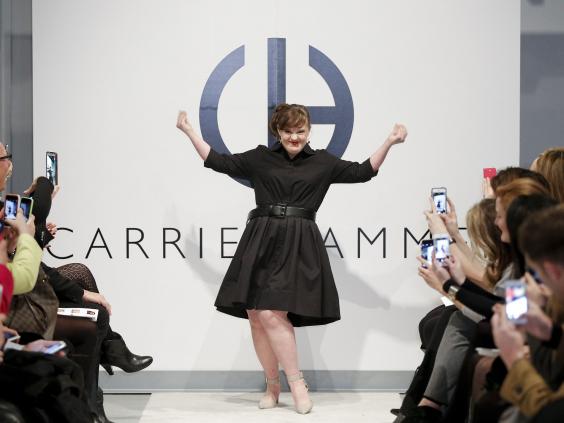

These are but a handful of the disabled models working around the world. Featuring in magazines and on runways.

Australia does have disabled models.

Madeline Stuart has walked in New York Fashion Week amongst others and has featured in numerous magazines, and now has her own clothing line, 21 Reasons Why.


The lovely Angel Dixon recently featured in Target's new campaign and has walked overseas for brands such Bezgraniz Couture.


Last year model and athlete, the gorgeous Robyn Lambird (I have serious hair envy) also appeared in a Target campaign.

A post shared by Robyn The Trex Lambird (@robynlambird) on


Yet here in Australia I am yet to pick up a magazine, other than a Target catalogue, and see a disabled model. I can flip through everything from Australian Women's Weekly to Vogue and no where do disabled models appear. (Update: Turia Pitt is currently on the cover of Australian Women's Weekly as the featured interview. Whilst not modelling per se, her position on the front of a such an iconic and well-known magazine is still incredibly powerful given how few people with facial difference appear in, let alone on the front cover, of well-known magazines. Of note her first cover in 2014, was the biggest selling of that year.)

When brands and companies proudly announce they are embracing diversity, disability is never part of the campaign (Think Vogue's 2017 attempt at a diversity cover. Problematic for so many reasons, one of which was their continued obliviousness to disability in their diversity brainstorming. Or local company Myer in 2016 alerting us to their new enlightened direction to move beyond the overwhelming whiteness in their shows. With no mention of age, size, or, disability.)

Brands continue to pat themselves on the back for embracing different races, plus-sized models and more recently older models, (which is all fantastic) 
but disability continually fails to be included in the mix.


Which leads to the question: do disabled people simply not exist in the minds of the Australian fashion industry?

I am a disabled 44-year-old woman who loves fashion. I use a walking stick and a wheelchair. I wear compression stockings. I dress up nearly every day. I celebrate self-expression through fashion. And I want to see myself and other disabled people represented on the catwalk and in the pages of multiple magazines. I want to know that the Australian fashion industry sees me, embraces me and values my existence. While I did love seeing Angel Dixon in the Target campaign recently, I am acutely aware how rare this experience is. With adults with disabilities largely forgotten by the industry.

I am not alone in my frustration. It is one shared by many other disabled people in Australia. Many of us, myself included, have not been happy to accept the status quo, instead creating our own fashion world on platforms such as Instagram (was rather excited to be part of this article by Revelist). We share our fashion expression and tips for dressing with style when using various mobility aides. We share knowledge of brands embracing disability (eg Target, Nordstrum, FTL Moda) or creating specifically with disability in mind (eg Bezgraniz Couture, Sue, Vanilla Blush). We note those companies who see our adaptive needs as a means to express ourselves (eg Alleles, Adaptive Limb Company, LympheDivas, Top and Derby, IzzyWheels).  In the process our presence is actively challenging societal perceptions of what disability looks like and how we live our lives.

Disabled people are actively engaging in fashion. 
Why isn't the industry here in Australia engaging with us? 

The vast majority of fashion brands including, or actively making clothing for disabled people are still located overseas (with current dollar conversion rates and postage, frequently making them inaccessible to Australian residents).

When will we see the same push for the inclusion and valuing of disabled people by the fashion industry here in Australia? We are continuing to lag behind the rest of the world when it comes to disabled models on the runway and in fashion magazines. Target and Kmart are still two of the few companies here in Australia including disabled models in their advertising, especially when it comes to adult fashion.

Organisations such as Startling with Julius are actively advocating for the inclusion of disabled people in advertising. Thanks to their hard work there has been a slow but perceptible increase in the inclusion of disabled children in campaigns. However adult representation apart from the aforementioned campaigns, remains sorely lacking.

It's not good enough.

In Australia 1 in 5 people are living with some form of disability (roughly 4,756,000 people). Why aren't we represented in advertising, in magazines or on the catwalk? Overseas numerous fashion weeks and magazines are including disabled models. From Russia to Ethiopia, South Africa to Mexico, Japan, the USA, Hungary, the Ukraine, the UK, the Netherlands, the list goes on, all have included disabled models. If they can see the value of inclusion and embrace the beauty of difference why don't we?

I ask the Australian fashion industry once again,

"Why don't you see me?"

Michelle

Musical accompaniment had to be the amazing Viktoria Modesta with Prototype.

Thursday, 30 March 2017

Metamorphosis: Marketing Medical Compression as Fashionable and Transforming the Narrative around Disability and Illness.

[Image: Nine photos 3x3 showing me wearing a variety of colourful compression stockings in a variety locations. The photos are all from the last year and reflect my changing hair colour from green to purple to pink. I am seated, in my wheelchair and standing with my walking stick.]

Note: The Juzo, Mediven, and Sue websites I've linked are not in English. Each page should give you a translation option, otherwise there is a translation icon that should pop up in the right side of the URL bar.


*****


Recently, the promotional video for the new season trend colours, was released by the German arm of compressionwear company, Juzo.


I sat watching with a huge grin on my face. Not only were the colours fabulous (Happy Red is a personal favourite), but the promotional video and the behind the scenes short film both framed medical grade compression in an energised, stylish, more inclusive and fashionable manner, not unlike what you would see for any fashion brand. A rarity in a market that sees clinical practicality as it's primary driving force.

This is not the first time I have been struck by Juzo's attempt to merge fashion into the medical grade compression world. In 2015 they released a similar video for their Urban Jungle range (below is the behind the scenes video for the range).


(The 2015 campaign sent me in search of their products. And the bright Kings Cross Yellow in particular became a favourite that I frequently wear.)


Both videos have moved medical grade compression stockings from the clinical, sterile, medical domain to a fun, stylish and normalised aspect of life. There is also a move away from a product primarily aimed at an elderly market (mind you 43 or 73 I want a bit of wow in my compression stockings) or a practical work component (eg nurses often wear compression stockings as they are on their feet all day).

Juzo are not the only company to actively seek to reposition their compression stockings away from a purely medical product to a fashionable product. Mediven showcased their Elegance range at Berlin Fashion Week 2016 (read more here). I love their write up and the photos showing how integrating medical grade compression and stylish fashion can be effortless and looks fantastic.


Both the Juzo and Mediven campaigns are exciting. They mark a distinct move in the market: where fashion has become an important part of design. This is a move that those of us who purchase these products have been seeking for a long time. It also represents a realisation that real people are wearing their products and that fashion matters to those wearers. This is a distinct move from a traditional medical products market that has historically designed for, and targeted, large organisations who's purchasing guidelines are based on practicality and fiscal responsibility.

The disability and illness communities have their own purchasing powers and no longer rely exclusively on organisations to provide them with products such as these. The proliferation of online shopping means that we are no longer beholden to the dictates of the medical system where we are told what is on offer and what we will receive. In a sense the middle man is removed from the equation and some companies are recognising that they need to market to the individual user. Though cost continues to be a limiting factor for many on low incomes and for those of us living in the Southern Hemisphere where postage and a poor $AU can create an added level of financial burden. Options to decrease costs and source sales are available but it can be time consuming.

They also change the narrative around a product that is often associated with a negative representation of increasing age or illness. A necessary evil that many must purchase, but hate due to the illness they represent, and a previous lack of attention to their aesthetic value that firmly places them into a hospital or medical model.

In reality, compression stockings increase functionality. As a long term user for me they represent an increase in endurance and a reduction in pain and swelling. They help to reduce my symptoms and in so allow me to do more. They add to my overall level of functioning and in turn aid me in getting the most out of life. And with these new ranges they can also be integrated into my personal style. A win on many levels.

Out the front of our local where we tend to always go for date night. You can see the stockings better in this one. They are @sigvaris (although @Jobst) do a similar pair). It can be hard to style #compressionstockings in Summer or it you're going out but it is possible. I wear them with shorts and dresses all the time. I don't pretend to have any fashion styling prowess, I simply wear what works for me, but if you are confident and forget they are a medical product it is possible. Especially with all the fashion options avaliable these days (check out my blog for links and reviews). * * I also take inspiration from fashion bloggers I love like @ladymelbourne who made me really think about personal style and confidence to take a chance and embrace what I really love. Or wheelchair and diasbled fashionistas like @itslololove and @cur8able (the idea of lengthening limbs when sitting by simple tricks like pushing up sleeves on a jacket are gold). And I broke out my high heels again in part thanks to @angelarockwood_official. There are so many amazing disabled and chronically ill fashionistas to take inspiration from. And it is possible to tweak current looks to be disabled friendly with a little thinking outside the box. * * I really wish we could see a more visible disabled presence on runways here in Australia. I wish we could see disabled fashion presented like you would any other (@IZadaptive did a great campaign this year but are sadly closing). The importance of that visible presence can't be underestimated for disabled and able-bodied alike. * * Fashion is for everyone and should be accessible for everyone. Across a whole host of styles for people who like fashion as a medium of self expression (gosh I love @viktoriamodesta avant-garde looks) or simply want to frock up on occasion. We aren't a niche. We are consumers with cash who want to wear fashionable clothes. #dysautonomia #chronicillness #disability #fashion #frockingup #fashionblogger #ootd #wiwt #everydaystyle #40plusstyle #wheelchair #wheelchairstyle #wheelchairfashion #disabledfashion #disabledstyle #streetstyle #ruraldisability #ruralstyle #ruralfashion #Australia #gippsland #upanddressed
A post shared by Michelle Roger (@michelle_roger) on

Fashion can increase usage rates.

Like many Dysautonomia patients I wear medical grade compression stockings every day. Prior to any pharmacological intervention they form an important component of first line treatment, alongside increased salt intake, increased fluids and a graded exercise program. We know that peripheral vascular flow is frequently impaired, as seen with visible blood pooling and swelling in lower limbs, and that this is part of a systemic process that contributes to many of the symptoms patients experience.*  However, the implementation and continuation of this management technique is often low.

Compression stockings are notoriously difficult to don and remove even with the various techniques and devices offered. They are also hot, a significant problem when you have a disorder in which thermoregulatory control is often impaired.


But by far the biggest complaint regarding medical grade compression stockings is related to how they look. 


Despite doctors frequently prescribing compression stockings to treat issues such as poor venous return or oedema there continues to be a lack of knowledge about fashionable options. Patients may be given a pair of  white TED stockings during a hospital stay, or head to their local chemist and find information about black, white, beige and perhaps navy. But any discussion of fashion tends to be confined to lamenting it's lack in the compressionwear market.


I have been writing about my search for fashionable compression stockings since 2012. At that time I was stuck in the compression purgatory that many patients face. I was given a scribbled prescription from my cardiologist with little to no information. I was to seek out a pair of 20-30mmHg waist high compression stockings. There was no information on brands or where I could source them beyond a vague "ask at the chemist." At my chemist I was met with confusion. Why would a then 33-year-old woman be asking about compression stockings? Were they for my grandmother?  I was shown a catalogue of limited styles and ended up with two pairs of very uncomfortable waist high, very practical, black compression stockings. It was a step up from the beige I had been offered originally but depressing all the same. Then in 2012 I found my first pair of coloured compression stockings and a new world opened up.

Since that time I have shared every fashionable option I have found with readers here on the blog, in support groups and on Instagram. It is like a new world opened up. Whilst always a practical medical item at their core, it became apparent that they could be matched to personal style. No longer were they something to be worn with spite and loathing. Instead there was a transformation and a normalisation of a medical product. A way to take back some control of my life from the relentless medical need. And I like many others wore their stockings with increased regularity and in turn increased functioning. (I feel a little like I should we lived happily ever after at this point!)

Where is the Disability Representation?

The Juzo video features a range of models, including a variety of body types, ages and sexes (although, unlike their 2015 campaign, only white models are used in 2017). I applaud their move towards diversity, something rarely found in the compression stocking advertising, however disability again is missing from the mix. This seems a surprising omission in what is at it's core a medical product. A quick scan of social media platforms such as Instagram, reveal a large population of disabled fashion lovers. The incredible work of Alleles prosthetic covers, the beautiful bespoke pieces created by The Alternative Limb Project, the increase in accessible fashion brands such as Bezgraniz Couture or Sue flourish thanks to a huge fashion loving disabled market seeking more fashionable options.

Disability representation for a product like medical compression should be part of any advertising campaign. And while the overall feel of this new wave of campaigns is very positive the neglect of a key group in the market is disappointing. I am cognisant that some of the models in these campaigns may have an invisible disability, I know prior to my need for mobility aides I looked very healthy despite my underlying medical issues, but the importance of visibly disabled models in campaigns such as these cannot be underestimated. Visibility changes how society feels about disability. Visibility changes how we feel about ourselves. I both love these campaigns and fully embrace the change in narrative surrounding a product with what could only be described as a PR problem, but I am disappointed that a disabled model is not part of the mix.

Advertising is often framed in terms of aspiration, in the case of the Juzo and Mediven videos a fun, stylish and energised life. Surely we as one of the largest user groups of these products, we should be included in this aspirational narrative. I know that many disabled fashionistas are living fun, stylish and energised lives, our inclusion seems obvious. While at a grass roots level we are gaining momentum in changing how we are viewed by choosing how we are representing ourselves, it would be nice for brands to come on board and follow our lead.


Where to from here?

Companies such as Juzo and Mediven are slowly changing the narrative around compression stockings. However, awareness and availability of fashionable compression stockings desperately needs to increase.

Even with fashionable products available in the market, their lack of visibility and availability, means that the more traditional and basic options continue to dominate and tend to be the only styles offered to new patients. We are stuck in a self-fulfilling prophecy where by patients don't request fashionable items because they don't know they exist and the gate keepers of these products don't stock them. And the gate keepers say that they don't stock them because no one is requesting them.

Whilst, medical professionals continue to prescribe compression stockings for a range of issues they are rarely aware of fashionable options and they have no idea that they can be integrated into our personal styles.

It is clear that a wider advertising campaign needs to occur. At present, information about fashionable options are shared patient to patient, on blogs such as this or other forms of social media such as Instagram, or on forums. This informal advertising whilst fabulous, is still haphazard and reliant on luck and at least one patient who spends her nights working her way through Google looking for new fashionable options and tries her hand at styling them. I'd love to see compression brands on more runways and in mainstream fashion advertising. Or taking tips from sporting compression companies such as Skins or 2XU who have moved from elite sporting environment to become household names and found in gyms and sporting fields all around the world.

And I would love to see disabled models featured in their campaigns. 

Like many in my position I spend enough time in the medical system and I have no desire to wear a piece of cold, clinical hospital every day.

What I do want is something that meets my practical needs but can also be incorporated into my personal style. I am happy to flaunt my bright yellow, or red, or green, or blue, or patterned legs all year round. To wear them with shorts or dresses. To get on with this business of living knowing that I can be both practical and fabulous.

Reframing a traditional medical product in the new wave of campaigns helps to change how we think about those that wear them. It helps to change how we feel about ourselves. So much of my life and the lives of those around me are dominated by medical needs. Reframing how we think about and relate to items like compression stockings helps to remove stigma and improves how users feel about themselves. Incorporating fashion into practical medical products is a simple way to change these attitudes. And a definite selling point.

Fashion, medical practicality and disability can coexist. Time for more companies to come on board.

Michelle

*There is also evidence of abdominal blood pooling, in particular in Neurocardiogenic Syncope (NCS), and abdominal binders/compression are now often recommended alongside waist high compression stockings.

Some more resources here on the blog:

Compression Stockings: From Beige to Brilliant 

Fashionable Compression Stockings 2016 Update: Options and Tips.

Rejuvahealth Review.


Allegro, Microfibre 20-30mmHg Black Thigh High Compression Stocking Review

LympheDiva Gauntlet Review.


Fashion blogging is not for the faint of heart

Goldfrapp's Happiness seems an appropriate musical accompaniment as fashionable compression stockings makes me very happy.